
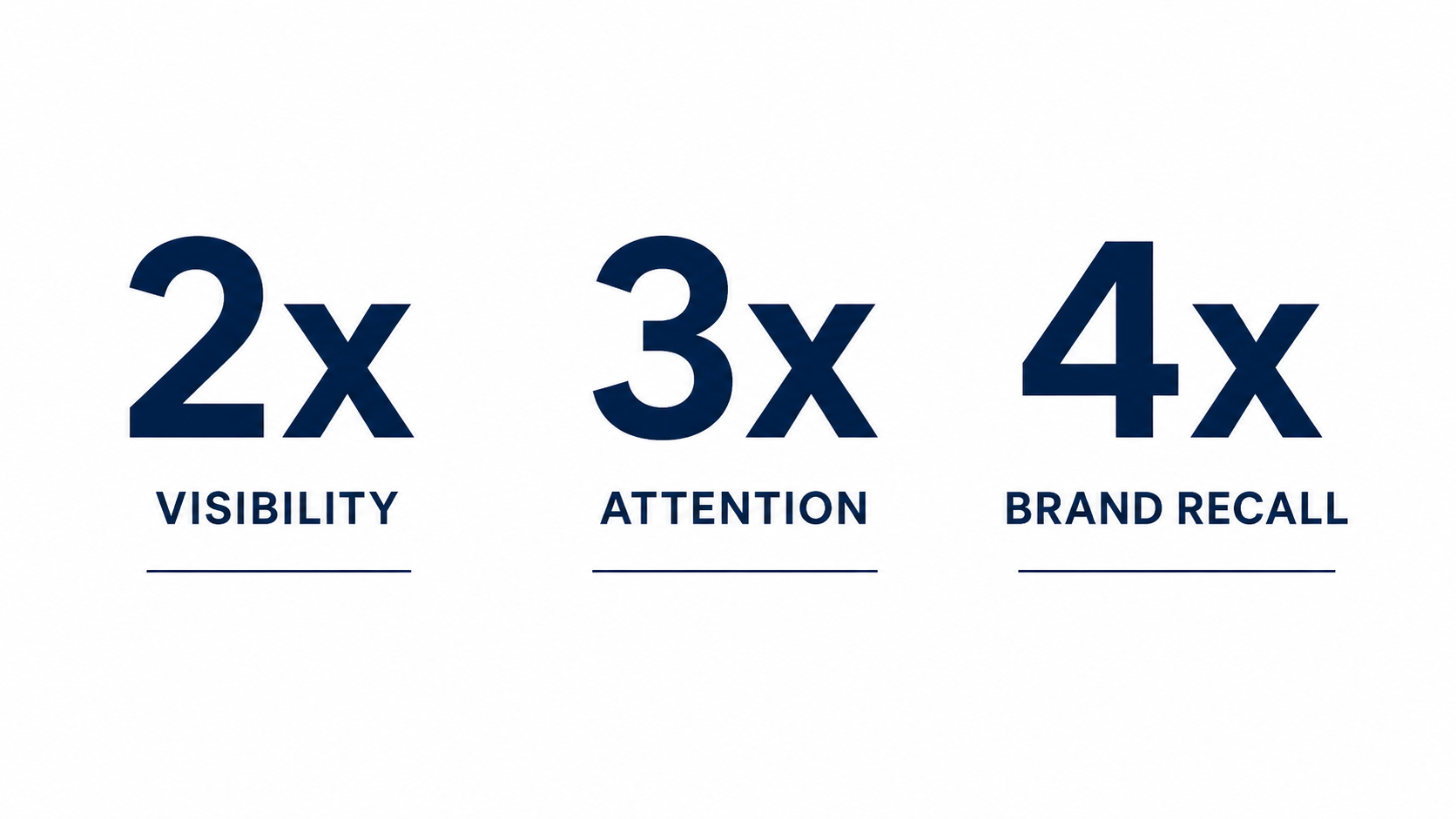
A 2025 UK eye-tracking study from Co-op Media Network and Lumen Research found that convenience store advertising delivers 2x the visibility, 3x the attention, and 4x the brand recall of campaigns in larger format stores.1 Most CPG marketers still buy c-store media as a sales activation tool, not a brand-building channel. The research, paired with a Canadian campaign that produced a 30% year-over-year sales lift, makes the case for moving c-store DOOH up the media plan.
What the UK eye-tracking study actually measured
Co-op Media Network ran the study with Lumen Research, an attention measurement company that uses eye-tracking glasses to monitor what shoppers actually look at, how long, and what falls within peripheral vision. 60 shoppers were assigned a 10-to-15-minute shopping mission across two store formats, a 2,106 sq ft small-format Co-op and a 14,687 sq ft large-format store closer to a supermarket.2 Brand recall and brand choice surveys followed each trip.
The result: shoppers in the small-format store had twice the opportunity to see in-store ads, gave them three times the gaze duration, and recalled the brands four times more often. Lumen then benchmarked retail media against traditional channels including out-of-home, online display, online video, and TV. Convenience retail media ranked second for brand recall across the full set, ahead of out-of-home, online banners, and social.1
This is the first eye-tracking dataset that compares c-store and supermarket attention head-to-head with independent measurement. It shifts the conversation from anecdote to evidence.
Three structural reasons c-stores outperform every other retail format
The findings line up with how c-store environments actually work.
A smaller footprint compresses the shopper journey. Every screen sits at close range. Ads cannot be ignored or walked past at distance the way they can in a 20,000 sq ft supermarket aisle. The shopper does not have a chance to filter the message out.
Mixed category aisles compound the brand impression. C-store shoppers cross snacks, beverages, OTC, lottery, and impulse categories in a single trip. Cross-category exposure builds memory faster than a single-category supermarket aisle.
Repeat exposure inside a single visit drives recall. The average c-store visit runs under 4 minutes and shoppers revisit the same aisles within the trip.3 Mike Follett, CEO of Lumen Research, framed the mechanic directly: small-store shoppers encounter the same ads multiple times within one trip, building memory through aggregate attention. That is the foundation of awareness, consideration, and intent.1
The Canadian sales lift that confirmed the pattern
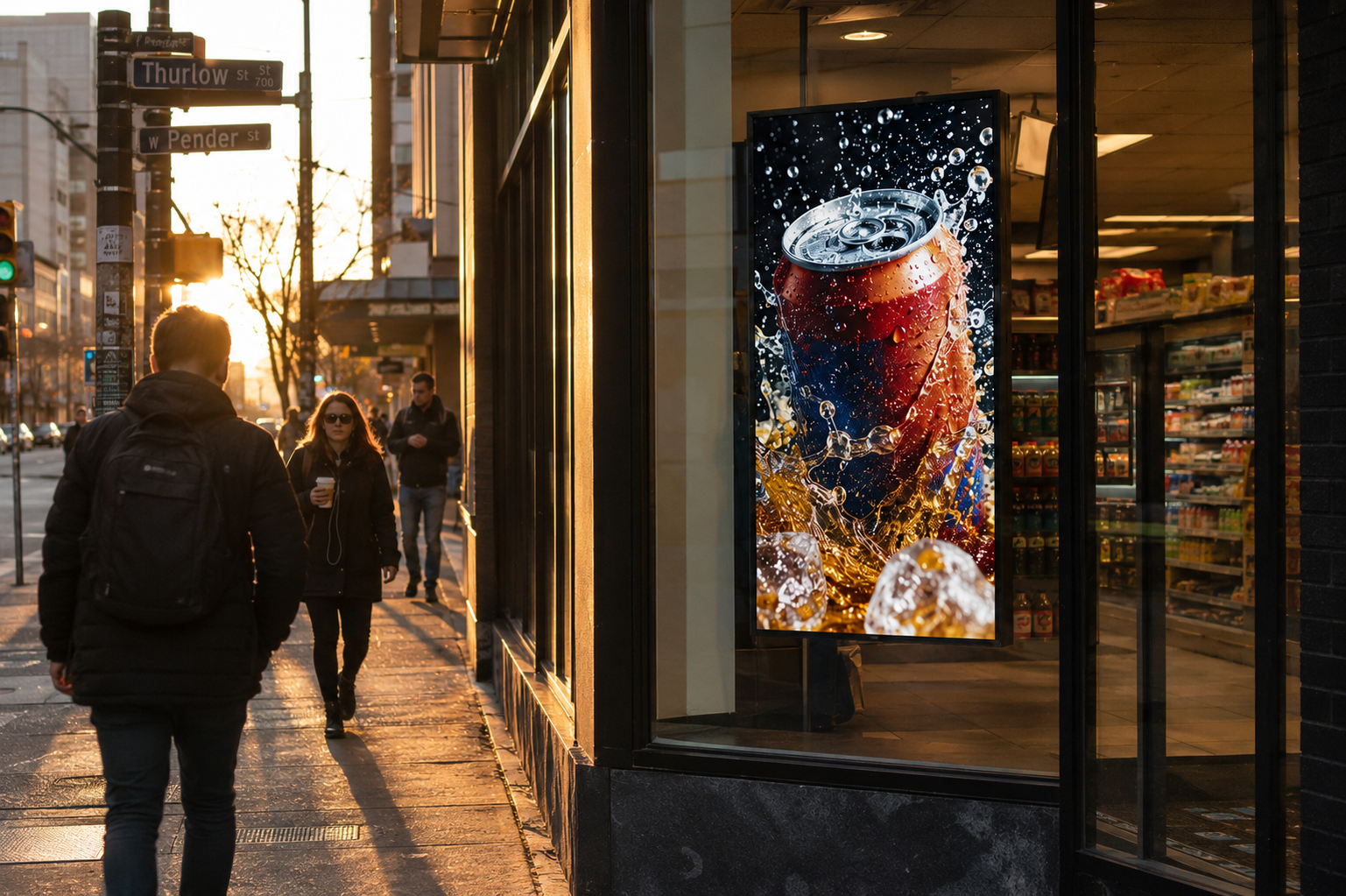
Adapt Media activated the same playbook in Canada with Excel Gum, a Mars Wrigley brand, across the Circle K network. 265 19-inch point-of-sale video screens ran for 8 weeks across 5 major Canadian markets and delivered 53.8 million impressions. The campaign produced a 30% year-over-year sales lift for the brand.4
The brief was difficult. Gum sales had declined 4 years running across the category, driven by reduced social interactions, shifting shopper behaviour, and post-pandemic health concerns. The c-store DOOH activation reversed the trend at retail in 8 weeks.
The pattern from the UK research, attention compounded by repeat exposure inside a small footprint, translated directly into measurable Canadian sales movement. The case for c-store DOOH is no longer hypothetical for a CPG planner deciding where to spend.
What this means for your next CPG media plan
C-store DOOH belongs in the consideration set alongside out-of-home, online video, and supermarket retail media for any CPG plan that needs both reach and brand recall. Few national networks combine c-store coverage at scale with attribution that ties DOOH exposure to retail sales movement, which is the structural gap most retail media buys still sit inside.
The case for moving budget into c-store DOOH rests on 4 points.
Sales lift is documented. The 30% year-over-year result with Excel Gum is a Canadian benchmark, not a UK extrapolation.
National coverage with neighbourhood relevance. The Circle K network and the Independent Convenience Store Network give CPG brands a national footprint with neighbourhood-level targeting, a combination few networks offer.
Attention is measured, not assumed. The Lumen methodology gives planners eye-tracking data they can stack against the gut-feel attention claims of competing channels.
Measurement integration. Adapt Media campaigns can be measured through Datalytica, which connects DOOH exposure to retail sales data, mobile retargeting, and conversion outcomes. Most c-store networks cannot deliver that level of measurement integration.
How to evaluate c-store DOOH in a pitch process
For media buyers and brand planners running an evaluation, 3 questions cut through the noise.
What attention data does the network have for its specific environment, and is it independent? Eye-tracking from a third party like Lumen Research carries more weight than a network’s internal claim.
What is the measurement story? A network that can connect exposure to in-store sales, mobile behaviour, and website conversions is a different planning conversation than one that can only deliver impressions and reach.
What is the network’s coverage profile against your category footprint? National scale matters less than overlap with the retail trade your brand actually depends on. For CPG brands selling in c-stores, the alignment is direct.
The UK study and the Canadian sales data have already validated the channel. The remaining work for your team is on the partner side.
To bring c-store DOOH into your next CPG plan, contact Adapt Media to walk through coverage, attribution, and category fit.
References
[1] Lumen Research. “Study with Co-op: In-store retail media attention.” https://lumen-research.com/white-papers/in-store-retail-media-attention-study/. Accessed May 2026.
[2] The Grocer. “Eye-tracking tech shows brand recall boost of convenience retail media spend.” https://www.thegrocer.co.uk/news/eye-tracking-tech-shows-brand-recall-boost-of-convenience-retail-media-spend/701407.article. Accessed May 2026.
[3] One Day Agency. “How to Advertise in Convenience Stores.” https://oneday.agency/blog/how-to-advertise-in-convenience-stores. Accessed May 2026.
[4] Adapt Media. “Excel Gum Circle K Canadian DOOH case study.” https://adaptmedia.com/contact. Accessed May 2026.
[5] Performance Marketing World. “Convenience store ads deliver twice the visibility compared to larger stores.” https://www.performancemarketingworld.com/article/1907777/convenience-store-ads-deliver-twice-visibility-compared-larger-stores. Accessed May 2026.
Internal links
Circle K Network. https://adaptmedia.com/product/convenience-store-advertising-network/#_CK
Independent Convenience Store Network. https://adaptmedia.com/product/convenience-store-advertising-network/#ICS
INS Network. https://adaptmedia.com/product/convenience-store-advertising-network/#INS