
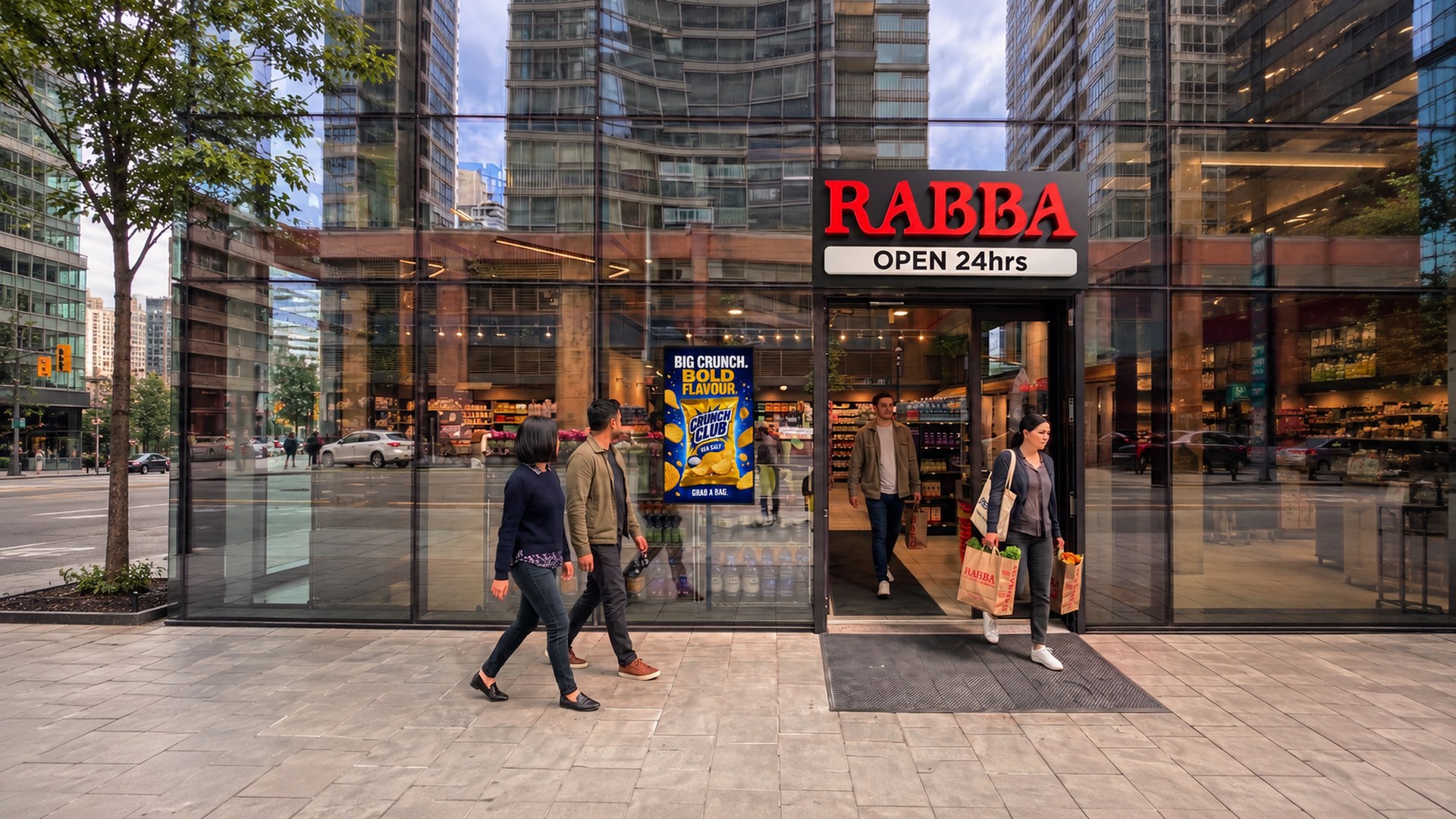
Canadian retail media ad spending will reach C$3.8 billion in 2026.1 Search anchors the performance case.1 The store is a different story. In the US, in-store media took 3.3% of retail media spend outside Amazon in 2025.2 Canada publishes no equivalent number. Here is where the money goes, what the research says about screens at the shelf, and how to plan in-store retail media in Canada with a test you can read.
Where Canada’s C$3.8 Billion in Retail Media Spending Is Going
Retail media is growing faster than digital advertising overall in Canada.1 It already accounted for roughly one-fifth of digital ad spending in 2025.3 Search carries the performance case, and offsite audiences sold across CTV, video and programmatic are a growing part of the mix.3
Much of that growth is not new money. A meaningful share comes from existing budgets reclassified or redirected out of programmatic, open-web display, print and linear TV.3 For a CPG brand, retail media now competes with the lines that used to fund awareness. The question for 2027 planning is no longer whether to buy retail media. It is which part of retail media earns the next dollar.
The store is the obvious candidate, and the audience is already walking in. 21.8 million Canadians 14+ shopped a convenience store in the past 30 days.4 Every one of them stood at a counter with snacks, drinks and confectionery within reach. The planning question is how much of the C$3.8 billion is built to reach them there.
Why In-Store Retail Media Gets 3.3% of the Budget in the US
The clearest benchmark comes from the US. In-store retail media was 3.3% of retail media spend outside Amazon in 2025.2 Over the same period, more than 80% of US retail sales still happened in physical stores.2 The spend and the sales point in opposite directions.
The reasons are practical, not strategic. About 1 in 4 retail media buyers say in-store reach is hard to access.2 Physical retail is fragmented. The top 15 US retailers account for less than 40% of retail sales, against nearly 70% of online sales for the top 15 ecommerce players.2 Each retailer runs its own screens, its own rate card and its own reporting, so buying the store means buying it banner by banner.
Search does not carry that friction. A sponsored listing is bought in a self-serve platform with standard reporting. Budgets flow to what is easy to buy and easy to report, not to where the purchase decision is made.
Canada has no published equivalent to the 3.3% figure, so Canadian planners should not assume their own split is healthier. The same frictions apply wherever store media is sold 1 retailer at a time.
What the Research Says About Point of Purchase Advertising
The strongest evidence on screens at the shelf comes from a 2026 peer-reviewed study of 237 in-store digital signage campaigns and 30 million shoppers. Digital signage lifted the likelihood of buying featured products by 8.1%.5
The detail matters more than the headline. The effect was stronger for low-priced, impulse and new products, for popular brands, in crowded stores, later in the day, and when the screen sat near the advertised product.5 Buyers did not change how much they spent, and the lift extended to other products from the same brand and category without pulling purchases forward.5 The authors read that as new consumption, not sales borrowed from next week.
The study was not run in Canadian convenience stores, so treat 8.1% as directional. The conditions it describes are a close match for convenience: small, busy stores, impulse categories, and screens a few steps from the product. We covered more of that evidence, including a Canadian sales lift, in our look at convenience store advertising effectiveness.
That is where Adapt Media fits. Adapt Media sells convenience screens across 5 networks as 1 national buy, so a brand gets point-of-purchase reach without negotiating banner by banner.
Convenience: The In-Store Retail Media Buy That Scales Across Canada
The Adapt Media convenience store advertising network covers 4,500+ locations with 5,000+ digital screens and 10,000+ static posters across 10 provinces and 3 territories. The 5 networks are Rabba, INS Market, Hasty Market, Circle K and independent convenience stores.
Adapt Media convenience screens run in 2 formats: window panels facing the street and at-cash screens inside the store. The at-cash screen is the placement the research describes, a screen beside the product at the moment of purchase, next to the gum, snacks and drinks that fill the impulse basket.
For a retail media planner, that changes 3 things. 1 contract replaces a long list of retailer conversations. The store list can follow the brand’s own distribution, so screens run where the product is stocked. And reach builds across chains and independents at the same time, which is hard to assemble 1 retailer at a time.
Exposure does not have to end at the door. Adapt Media mobile retargeting extends DOOH exposure to 22M+ Canadian phones, so the brand can follow up online after the store visit. For more on how Adapt Media fits the wider category, see retail media networks in Canada.
Retail Media Budget Allocation: How to Move Money In-Store
Moving budget into the store does not need a leap of faith. It needs a test designed to be read. 3 decisions set that up.
Start with a test cell
Fund in-store as its own line, not as whatever is left after search. Size the cell so the result is readable: enough stores, enough weeks, and a clear comparison. A token flight across a handful of stores produces noise, and noise gets cut in the next planning round.
Build the store list from distribution
Run screens where the SKU is on the shelf. Match the store list to distribution data, then hold back comparable stores as a control group. The research found the lift was strongest near the product, so a screen in a store that does not carry the item is wasted spend.
Agree the measurement plan before launch
Decide the KPI, the data source, the baseline period and the control stores before the first spot runs. Unit sales from retailer or syndicated data give the cleanest read. Settle the method with Adapt Media and the brand’s insights team up front, so nobody debates it after the results arrive. Out-of-home already has evidence as a performance channel, and in-store puts the screen closest to the sales data. Our next post walks through how to measure DOOH advertising step by step.
The C$3.8 billion will be spent either way. Brands that test in-store now will know their number before the next planning cycle. Contact the Adapt Media sales team to scope a test cell and a store list for your brand.
References
- EMARKETER. “Canada Retail Media 2026.” Paul Briggs, January 23 2026. https://www.emarketer.com/content/canada-retail-media-2026.
- EMARKETER. https://www.emarketer.com/content/faq-on-in-store-retail-media–closing-gap-between-demand-execution.
- Canadian Marketing Association: https://www.thecma.ca/topic/articles/2026/08/05/retail-media-in-canada-what-s-driving-the-growth.
- Vividata: Spring 2026
- Herhausen, D., de Jong, D. and Grewal, D. “In-Store Advertising with Digital Signage.” Journal of Marketing, vol. 90, no. 3, 2026, pp. 91-103. https://doi.org/10.1177/00222429251351578.